22 September 2026 · 5 min read
Types of Flowers in Bouquets: A Visual Identification Guide
Recognize six common bouquet flowers by petals, leaves, and flower structure, with labeled illustrations, real Baqah examples, and botanical sources.
What is the ruffled pink flower beside the rose? Is that open white bloom a lily, or just a pale flower with pointed petals? Identification becomes easier when you stop starting with color. Look at the outline, the flower's center, how blooms attach to the stem, and any leaves still present. This guide introduces six common bouquet types, not every florist's variety or a definitive species-identification key.
How to use the pictures
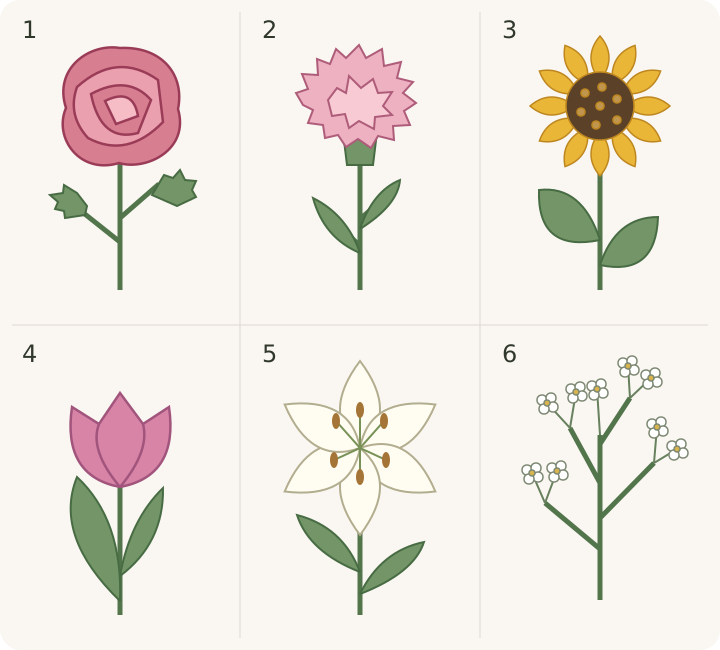
Original identification illustrations, simplified and not to scale. Numbers match the sections below. These are not photographs; they highlight features to investigate in a real specimen. Double-flowered cultivars, closed buds, and removed leaves can conceal those features.
Photograph a real bouquet from the front and side before separating anything. Include a whole stem and a leaf, if available. Compare at least two characteristics rather than treating one petal shape as proof. The botanical links below contain reference descriptions and photographs for further comparison.
1. Rose: overlapping petals are only the beginning
Many florist's roses have nested, overlapping petals, but some garden roses are much more open. Look for toothed leaflets and, where retained, stem prickles. NC State's Rosa profile documents these useful supporting features.
In a bouquet, start by looking under the bloom instead of guessing from its circular outline. A florist may have removed the prickles and lower leaves, so their absence does not rule out a rose. Compare Red Roses with the mixed examples below. A tightly packed center alone cannot reliably distinguish a rose from every ranunculus or peony; the peonies, roses, and ranunculus comparison explores that particular confusion.
2. Carnation: inspect the edge and the base
A carnation's frilled petals sit above a tubular green calyx; its narrow leaves provide another clue. See Dianthus caryophyllus.
Turn the flower sideways and ask whether the petal mass emerges from a long green cup. That side view is often more informative than a front-facing picture filled with ruffles. In Blush Carnations & White Roses, compare the suggested ruffled pink heads with the smoother overlapping rose shapes. Illustration detail is selective, so use it to learn the contrast, not to certify a cultivar. Do not assume every round pink flower is a carnation.
3. Sunflower: a disk surrounded by rays
The familiar sunflower head contains central disk florets surrounded by ray florets. Helianthus annuus explains that structure.
Look first for the broad center, then inspect the whole head and any attached foliage. A dark center and yellow surround suggest a sunflower but are not exclusive to it. Avoid identifying every daisy-shaped flower by this color pairing. For an easy visual exercise, compare the large golden heads with the much smaller blue flowers in the Baqah illustration below. They occupy different roles and have very different outlines even at thumbnail size.
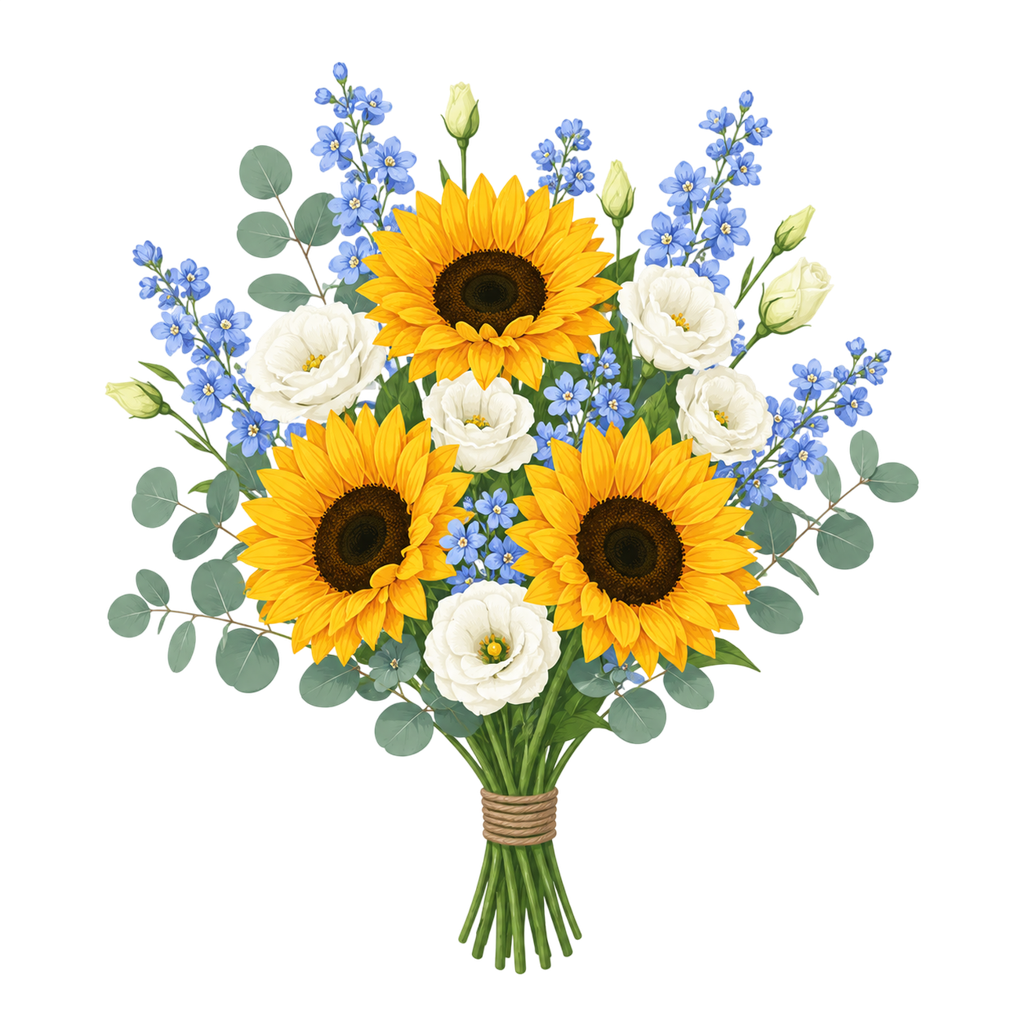
Baqah bouquet illustration, not a botanical photograph. The catalog names this composition Sunflowers & Blue Delphinium; those names describe the intended design, not an independent identification of each painted detail.
4. Tulip: a cup, with important exceptions
Typical single tulips show six tepals and broad, clasping leaves. NC State's Tulipa profile also records the diversity of flower forms.
A tepal is a petal-like part used when petals and sepals look similar. In practice, observe whether the bloom forms a simple cup and whether a broad leaf wraps around the stem. Do not pull apart a closed flower to count its parts. Double or fringed tulips can depart strongly from the familiar outline. Pink Tulips & Freesia is a starting point for recognizing the intended cup silhouette, not proof that every cup-shaped flower is a tulip.
5. Lily: count the parts around the center
Typical single lilies have six tepals and six stamens. Check the Lilium reference rather than relying on white color.
Follow the petal-like segments toward their shared center. In an open bloom the projecting stamens can make the structure much easier to read. Some florist's flowers have had anthers removed, and double forms complicate counting. The drawing above deliberately shows a simple open form. Common names containing “lily” do not always mean the genus Lilium, so keep a provisional label until the rest of the plant agrees.
6. Baby's breath: look at the branching spray
Gypsophila carries many tiny flowers on branching stems, rather than one dominant head. See Gypsophila paniculata.
Trace one branch from its base to the small blooms instead of identifying a whole white cloud at once. Individual flowers may be too small to resolve in a message preview. In Gypsophila & Red Roses, the filler creates a fine texture around much larger rose heads. Other small white flowers can play the same design role: “filler” describes a job in the arrangement, not a botanical identity.
Put the clues together
Use three columns in your notes: likely name, visible evidence, and what is missing. “Rose-like head; leaves hidden” is more useful than an unjustified exact species. For additional lookalikes, see flowers that look like roses. Once you recognize the forms, the color combination guide helps you choose how they work together. Do not use this visual overview to decide whether a plant is edible or safe for pets.
Frequently asked questions
Can I identify a flower from its color alone?
No. Many unrelated flowers share colors. Use the bloom structure and at least one additional feature, such as leaves or the calyx, before making a tentative identification.
Are these images photographs of real specimens?
No. The numbered diagram and Baqah bouquet are illustrations. Use the linked university profiles for botanical descriptions and reference photographs.
Why does my double tulip look like a peony?
Extra petal-like parts can hide the usual outline. Check leaves and stem structure, then compare the florist's label; a full rounded head does not settle the identification.
Can a bouquet name confirm the species?
Not necessarily. Catalog names describe an intended composition and may use broad common names. Ask the florist or supplier for the botanical name when exact identification matters.