22 September 2026 · 5 min read
Flowers That Look Like Roses: Beautiful Alternatives for Bouquets
Explore rose-like lisianthus, ranunculus, peonies, carnations, double tulips, dahlias and camellias, with practical bouquet choices.
What do you love about a rose: its folded center, rounded silhouette, abundant petals or the feeling it brings to a bouquet? Those are different qualities, and different flowers can echo them. Choosing a rose alternative works best when you name the feature you want to preserve rather than searching for an exact botanical duplicate.
This is a selection guide, not an identification key or a promise that every flower below can be ordered everywhere. Cultivar matters especially: a single lisianthus and a very double lisianthus can create quite different effects. Also, a “garden rose” is still a rose, not a non-rose substitute.
Match the Feature, Not Just the Color
| Desired effect | Start with | What changes |
|---|---|---|
| Soft, rose-like cup | Double lisianthus | A lighter, branching arrangement |
| Close, delicate layers | Double ranunculus | A more finely layered focal point |
| Full, generous volume | Double peony | A broader, less tightly ordered outline |
| Ruffled texture | Carnation | Fringed edges rather than a smooth spiral |
| Rounded spring bowl | Double tulip | A different silhouette as it opens |
| Bold geometric form | Decorative dahlia | More regular visual rhythm |
| Sculpted garden rosette | Double camellia | Specialist handling and sourcing |
Seven Alternatives Worth Discussing
1. Double Lisianthus for an Airy Cup
Lisianthus, sold under Eustoma, is a particularly useful starting point when you like a rose's cupped outline but want a looser arrangement. Ask specifically for double-flowered varieties. Branching stems can offer an open flower alongside buds, so discuss how that structure will fit the design rather than counting each stem as one rose. NC State confirms double cultivars and its use as a cut flower.
2. Ranunculus for Fine Layers
Double florist ranunculus offers the visual pleasure of closely packed petals without needing to imitate a rose exactly. It suits a design where repeated rounded flowers are the main detail. Choose the actual flower size with your florist: “ranunculus” does not guarantee a miniature bloom. The RHS growing guide identifies Ranunculus asiaticus as a cut-flower choice; our three-flower comparison explains the identification differences.
3. Peonies for Abundant Volume
A double peony is a strong candidate when your reference picture shows broad, soft, romantic fullness rather than a neat pointed center. Let it be the focal flower and leave room around it. Specify double forms, because peonies also include open-centered flowers. The RHS peony guide explains that range. Ask about local availability rather than treating a northern spring season as a worldwide promise.
4. Carnations for Ruffled Texture
Carnations contribute rounded volume, but their frilled petal margins create a different surface from many roses. That difference can be an advantage: choose a restrained palette and let the texture do the work. Do not assume that any alternative is automatically cheaper; compare a complete arrangement at your local florist. NC State's carnation profile describes the ruffled flowers and florist use.
5. Double Tulips for a Spring Bowl
Double tulips can echo the bowl of a full rose or peony. They remain tulips, not peony hybrids. Look at the chosen cultivar both partly open and fully open before deciding how formal the finished bouquet should be. The RHS describes Double Late tulips as having large, fully double flowers in late spring under its growing conditions. That garden description is not a delivery calendar for every country.
6. Dahlias for Deliberate Structure
Some decorative dahlias offer layered fullness, while other forms look nothing like a rose. Choose by the actual bloom rather than the genus name. They are a good design conversation when you want a statement flower with a more patterned appearance. The RHS dahlia guide shows their wide range and recommends selecting open cut blooms; do not buy tight dahlia buds expecting them to behave like rosebuds.
7. Camellias for a Garden-Inspired Detail
Double camellias can have striking rosette forms. Their glossy, leathery leaves help distinguish the plant from a rose; see NC State's camellia profile. For a hand-tied or transported bouquet, treat them as a specialist request, not a default replacement. Ask a florist whether the available material and construction suit the event. A beautiful garden flower is not automatically interchangeable with a standard florist stem.
A Digital Example, Not an Identification Photo
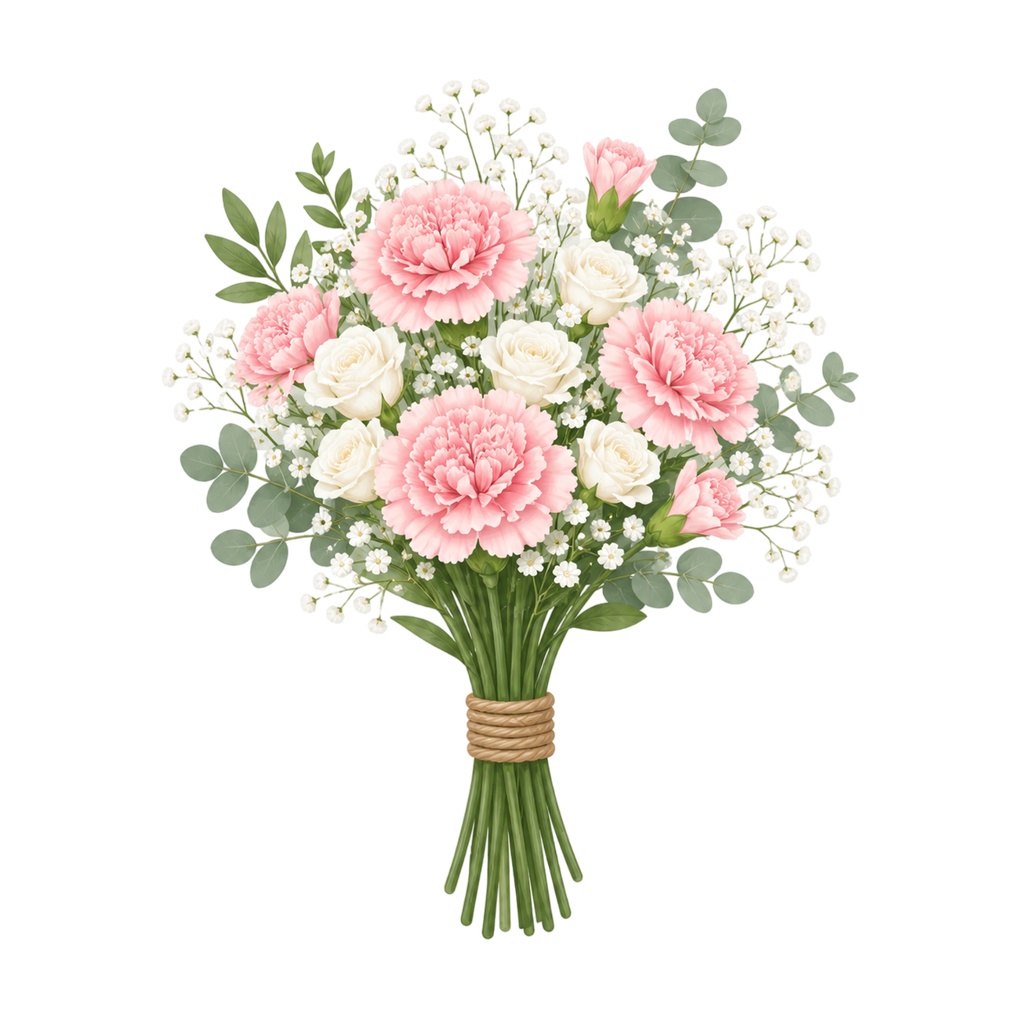
Baqah's Blush Carnations & White Roses illustrates a design idea: ruffled and smoother flowers can share one palette. This stylized catalog artwork is not evidence for identifying a real flower. For another combination, Peach Roses & Lavender includes creamy ranunculus alongside peach roses. These links are for digital bouquets, not fresh-flower orders.
Brief Your Florist Clearly
Bring one reference and say what matters: “I like the rounded outline and cream color; the species can change.” Add the date, budget, transport time and desired bouquet size. Ask which substitutions preserve that effect and which would change it. Compare finished designs, not merely prices per stem. For a digital gift, choose a composition you enjoy and write a personal message without claiming the pictured flowers have been botanically verified.
Frequently Asked Questions
Which alternative looks most like a rose?
Double lisianthus and ranunculus are useful starting points for cups and layers. For a broad garden-rose effect, consider double peonies. There is no single winner across all cultivars.
Are garden roses an alternative species?
No. They are roses. They may solve a style preference, but not a request to avoid roses altogether.
Are lookalikes cheaper or longer-lasting?
Not necessarily. Local supply, cultivar, condition and the finished design matter. Ask for a specific quote and care guidance instead of relying on a universal ranking.
Can all seven go in the same bouquet?
Do not assume so. Availability, scale and construction may conflict. Choose one focal effect and let the florist suggest compatible supporting flowers.
Sources and Related Reading
Botanical sources are linked beside each selection. The visual matches are design judgments, not taxonomic relationships.