22 September 2026 · 5 min read
Peonies vs Roses vs Ranunculus: How to Tell Them Apart
Compare petals, leaves, stems and buds to distinguish peonies, roses and ranunculus, including the tricky double-flowered varieties.
A pink flower with a hundred-looking layers is not automatically a peony. A garden rose can open into a broad, ruffled bowl, while a double ranunculus can have a surprisingly rose-like center. The quickest useful approach is to examine the flower, then check the leaves and stem belonging to that same bloom. Color alone cannot settle the question.
This guide compares the cultivated flowers commonly encountered in bouquets: herbaceous peonies, roses and florist ranunculus, usually cultivars of Ranunculus asiaticus. It is not a key to every species in these genera, and a tightly cropped photograph may not contain enough evidence for a confident identification.
A Visual Starting Point
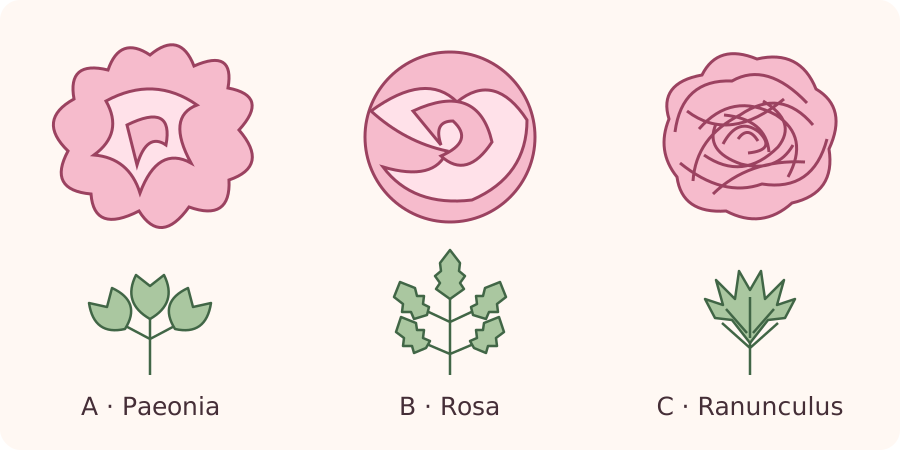
Original schematic, not photographs or a botanical identification plate. A suggests loose ruffles; B, a folded central cup; C, closely nested layers. These are memory aids for selected double forms, not universal shapes, exact petal counts or relative sizes. Read the qualifications below before using them.
| Check | Peony | Rose | Florist ranunculus |
|---|---|---|---|
| Double flower | Often broad and loosely ruffled | Folded cup, spiral or rosette | Many fine, closely overlapping layers |
| Foliage | Divided leaves with substantial segments | Compound leaves with toothed leaflets | Deeply lobed or dissected leaves |
| Stem clue | Herbaceous in the peonies discussed here | Woody plant; often has prickles | Herbaceous, without rose-like prickles |
| Main trap | Not all peonies are double | Garden roses may look like peonies | Large cultivars defeat size shortcuts |
Look Beyond the Petals
Peonies: start with the generous, uneven folds of a double flower, but do not stop there. Single and semi-double peonies also exist, so an exposed center does not exclude them. Follow the stalk down to its divided foliage. The RHS peony guide documents the range of flower forms; Kwantlen Polytechnic University's plant record describes the divided leaves of Paeonia lactiflora. Tree peonies are a separate complication: “peonies always have soft stems” is not a safe general rule.
Roses: many familiar cut roses have a high central fold, but garden roses can be cupped, densely packed or arranged in a rosette. Look for separate toothed leaflets arranged along a common leaf axis. The sharp projections often called thorns are botanically prickles. Their presence is useful evidence; their absence is not proof against a rose, because varieties differ and florists may remove them. NC State's Rosa profile supports these stem and leaf distinctions.
Ranunculus: the double florist forms often resemble fine layers of paper nested around a center. The stalk may look comparatively delicate, but thickness varies and is not a diagnostic measurement. Lobed, finely divided foliage strengthens the identification. Remember that florists frequently strip it away. NC State's ranunculus profile describes both double cultivated flowers and dissected leaves; the wild species need not resemble a densely layered florist bloom.
A Three-Step Check on a Real Bouquet
- Isolate one stem visually. Mixed arrangements contain foliage from other plants. A eucalyptus leaf beside a peony tells you nothing about the peony's identity.
- Compare front and side views. Notice the central arrangement, outer petals and the attachment beneath the bloom. Ask for a picture with an attached leaf, not just a closer crop of the center.
- Cross-check the label. A florist's variety name or supplier record can resolve a flower-only photograph that morphology cannot. Keep “probably” in your answer when evidence is incomplete.
Bud roundness, fragrance and diameter are supporting observations, not verdicts. Flowers change as they open, scented and less-scented cultivars exist, and scale is easily distorted in photographs. Avoid rules such as “the biggest one is the peony” or “a fragrant flower must be a rose.”
Choosing Between Them
For a physical arrangement, describe the effect you want: a few expansive focal flowers, a structured cup, or repeated little layered accents. Ask the florist to show the actual cultivar and its expected opening stage. Replacing one stem with another may change spacing, balance and the number of stems needed. Request a quote for the finished design rather than assuming a universal price ranking.
Garden flowering seasons are not a worldwide shop calendar. Climate, protected cultivation and imports affect availability. For an event, confirm supply for the place and date, and agree on a substitute that preserves the shape or color you care about most.
For digital inspiration, Baqah has The Peony & Azure Bloom, Fuchsia Ranunculus and Peach Roses & Lavender, whose catalog includes roses and creamy ranunculus. These are digital arrangements, not botanical reference images or promises of fresh-flower delivery.
Frequently Asked Questions
Is a peony a type of rose?
No. Peonies belong to Paeonia and roses to Rosa. A similar double flower does not make them the same plant.
Can ranunculus be as large as a rose?
Their cultivated sizes can overlap. Without a scale and supporting foliage, size alone is unreliable.
Does a smooth stem rule out a rose?
No. A rose may have few prickles, or the florist may have removed them. Check its attached leaves too.
Can I identify a flower from a bouquet illustration?
Not reliably. Decorative illustrations can simplify or combine features. Use a real specimen, verified photographs and a named source when identification matters.
Sources and Related Reading
The university and RHS references linked above support the botanical comparisons; the schematic and bouquet design suggestions are editorial aids.